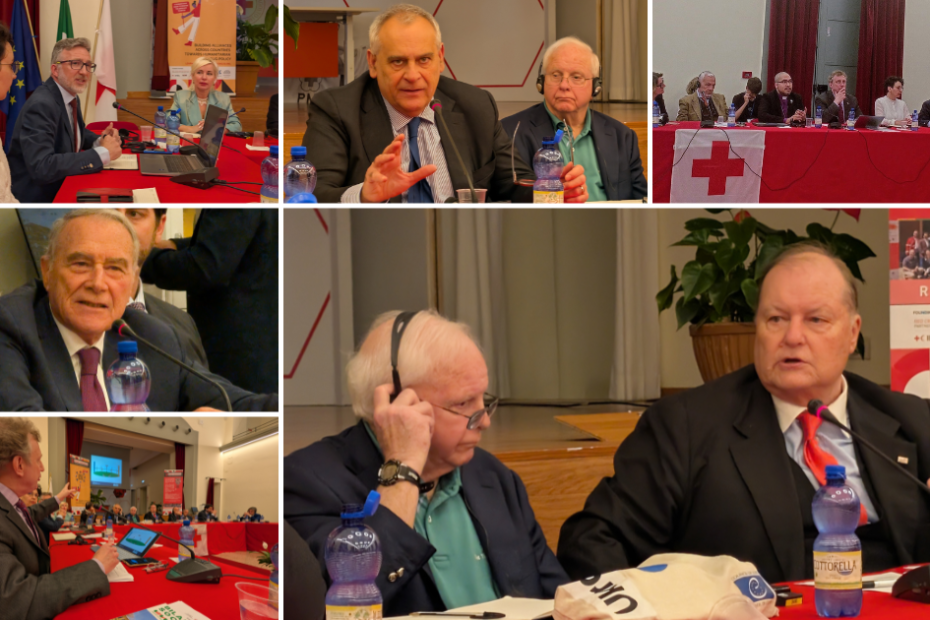
“No one is beyond help, not even when everything seems lost.” That spirit echoed through the halls of Villa Maraini-Croce Rossa on May 21st, where international experts, law enforcement, health professionals, and civil society met to confront one of our era’s most urgent public health and human rights challenges: drug abuse and dependence.
Hosted in collaboration with the Italian Red Cross, the forum “Drug Emergency: Can Law Enforcement Play a Therapeutic Role?” was not a typical policy meeting. It was a call to action. This is an invitation to rethink how we treat people who use drugs—not as criminals, but as human beings in crisis, in need of care, dignity, and options.
Breaking Down Silos: From Repression to Humanitarian Intervention
Villa Maraini’s decades-long emergency response model in Rome is an example of what happens when systems stop working in silos. Since 1994, their teams have carried out over 10,000 emergency interventions—often during arrests or medical crises—partnering directly with police precincts, judicial authorities, and hospitals. It is a testament to the power of cooperation between the health and security sectors.
This alliance is more than operational. It is a shared humanitarian commitment, echoed by Massimo Barra, founder of Villa Maraini and honorary president of the Italian Red Cross. “Violence only generates more violence. But if we integrate repression and care, we can actually save lives,” he stated.
From Punishment to Possibility: Learning from International Experiences
One of the central themes was the urgent relevance of deflection and diversion strategies—innovative U.S. approaches that reroute individuals away from incarceration and toward treatment and support. These models have shown a measurable impact: a 37% reduction in deaths linked to synthetic opioids like fentanyl in just one year.
Rome Consensus 2.0 delegates from across Europe and the U.S.—including PTACC, TASC, the C4 Recovery Foundation, and the Knowmad Institut—joined the discussion to explore how such models could be adapted for the Italian context. Could a coordinated response between police and healthcare teams become the norm rather than the exception?
Ethics, Coercion, and Human Rights: Drawing the Line
The forum did not shy away from tough questions. Could law enforcement apply “therapeutic coercion” during arrests, not to punish but to push toward treatment? Could a humane, rights-based intervention exist outside the conventional mental health mandate (T.S.O.)? The questions sparked deep ethical reflection—but also a sense of possibility.
As Rome’s Prefect Lamberto Giannini noted, “We must face this challenge together. Being present, offering medical care, and staying engaged in our communities is the only way forward.”
The Rome Consensus 2.0: A Global Platform for Local Solutions
Events like these are why the Rome Consensus 2.0 exists: to amplify humane, evidence-based drug policies that prioritize health, human rights, and social justice. What happened in Rome on May 21st is more than a local event. It is a microcosm of the global shift we are advocating for: from punitive systems to integrated, compassionate responses that save lives and restore dignity.
We are grateful to all partners, experts, and frontline workers who continue to push boundaries and rethink the possible.
Let’s continue building bridges—between sectors, between countries, and above all, between people.